A pressure washer tested on a perfectly clean driveway has little visible dirt to remove, so the demonstration tells you very little about cleaning performance. To judge a review, look for a clearly dirty test area, consistent passes, and enough detail to understand the machine, nozzle, and technique—not just a polished after shot.
Reviews · Sat Sep 19
Reviewers testing on a perfectly clean driveway
A spotless driveway may look good on camera, but it cannot show how well a pressure washer removes grime. Look for a dirty test area, consistent technique, and clear details about the machine and surface.
Why a spotless driveway is a weak test
If there is no visible buildup before the demonstration, it is hard to tell whether the washer removed anything. A clean surface also cannot reveal how long a real job takes, whether the cleaning is even, or whether the operator had to make repeated passes.
A convincing-looking video can still be useful for showing controls, handling, noise, or setup. But it should not be treated as evidence of driveway-cleaning ability unless it shows a meaningful before-and-after area under understandable conditions.
Pressure washer for driveway cleaning
 KÄRCHER Concrete & Driveway Cleaner for Pressure Washers, up to 40 GalKÄRCHER
$17.99 as of
View on Amazon Westinghouse ePX3050 Electric Pressure Washer, 2100 Max PSI 1.76 Max GPM with Foam Cannon and…Westinghouse
$109.00 as of
View on Amazon Hourleey 30" Pressure Washer Surface Cleaner with Dual Handles, Stainless Steel Surface Cleaner with 4…Hourleey
$299.99 as of
View on Amazon
Product prices and availability are accurate as of the date/time indicated and are subject to change. Any price and availability information displayed on Amazon.com at the time of purchase will apply to the purchase of this product.
What a useful driveway test should show
- A visibly dirty, representative area: The test should show the starting condition and include ordinary driveway grime. Different stains—such as oil, rust, or organic growth—may need different treatment, so one patch does not prove performance on every stain.
- The same area before and after: A split section or clearly marked boundary makes the result easier to judge than a cut between unrelated surfaces.
- Consistent technique: Watch for steady movement, overlapping passes, and a consistent distance from the surface. Moving more slowly or holding the nozzle closer can make a result look stronger, but may increase the risk of surface damage.
- The setup details: Useful reviews identify the pressure washer and explain which nozzle or surface-cleaner attachment was used. Water supply, detergent, and technique can affect results too.
- Time and coverage: A small clean patch may not show how efficiently the machine handles a full driveway. Look for a stated test area or a continuous view of the work rather than relying on a quick montage.
Compatible attachment for cleaning broad concrete areas
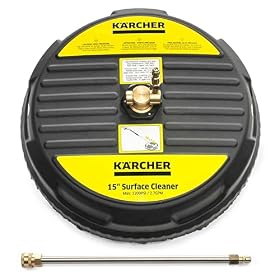 Kärcher Pressure Washer 15" Surface Cleaner Suitable for 2600 to 3200 PSIKÄRCHER
$64.99 as of
View on Amazon Dalmbox 16.5" Pressure Washer Surface Cleaner, 4-Wheel, 1/4” Quick ConnectDalmbox
$77.99 as of
View on Amazon VEVOR 16.5" Pressure Washer Surface Cleaner, Raised Handle, Stainless SteelVEVOR
$121.99 as of
View on Amazon
Product prices and availability are accurate as of the date/time indicated and are subject to change. Any price and availability information displayed on Amazon.com at the time of purchase will apply to the purchase of this product.
Read PSI and GPM in context
PSI describes water pressure; GPM describes water flow. Both affect cleaning, but a higher PSI number alone does not guarantee a better driveway result. Flow, the nozzle or attachment, the surface condition, and the operator’s pace all matter.
For driveway work, pay attention to whether the review uses a surface cleaner and whether it is compatible with the washer’s pressure and flow. A surface cleaner can make broad concrete areas easier to clean evenly, but an attachment that is not matched to the machine may perform poorly. Check the washer and attachment manufacturers’ compatibility guidance before buying.
Check that the test is safe for the surface
Concrete can be damaged by overly aggressive pressure, a close nozzle, or repeated passes over a weak or deteriorated area. A demonstration that shows fast cleaning is not automatically a good example to copy.
Follow the pressure washer manufacturer’s instructions, start with a less aggressive setup, and test an inconspicuous spot. Keep the nozzle moving and avoid directing high-pressure spray at people, pets, electrical equipment, or fragile materials. If the concrete is cracked, flaking, or otherwise weak, consider a gentler cleaning method or ask a qualified professional.
How to use reviews when choosing a washer
Give more weight to reviews that disclose the test conditions and show the work continuously. Treat spotless-driveway footage, unexplained before-and-after edits, and claims based only on PSI with caution. Compare machines using the type of job you actually have, the available water supply, and the attachments you plan to use.
If a review does not show meaningful cleaning, it may still help with setup or handling—but it cannot settle whether that washer will clean your driveway well. Look for another demonstration on a similar surface and with comparable buildup before making that judgment.
FAQ
Can a pressure washer review prove performance on a clean driveway?
Not by showing a spotless surface alone. Without visible dirt and a clear before-and-after comparison, the video offers little evidence about cleaning ability.
Is higher PSI always better for cleaning a driveway?
No. PSI is only one factor; water flow, nozzle or attachment, technique, and the condition of the concrete also affect results. Excessive pressure or an overly close nozzle can damage concrete.
What should I look for in a driveway-cleaning demonstration?
Look for a visibly dirty test area, the same area shown before and after, consistent technique, disclosed equipment and attachments, and enough coverage to judge the work.