More PSI can etch concrete because a powerful, concentrated stream may remove the thin cement paste at the surface, leaving rough marks or exposed aggregate. PSI is only part of the risk: a narrow nozzle, close working distance, slow movement, and weak or decorative concrete can make damage more likely. Start with a less aggressive setup and test an inconspicuous area before cleaning the whole surface.
Nozzles & Surfaces · Thu Sep 17
Why more PSI etches concrete
A concentrated pressure-washer stream can strip concrete’s surface paste and expose aggregate. The risk depends on more than PSI: nozzle, distance, movement, and the condition of the concrete all matter.
How pressure washing etches concrete
Concrete is not a uniform, indestructible slab. Its surface has a cement-paste layer over sand and stone. If the water stream removes that paste, the surface can become rough, pitted, or streaked. Once aggregate is exposed, ordinary washing will not put the surface back the way it was.
A narrow or damaged nozzle concentrates the water into a smaller area. Holding it close or lingering in one spot adds to the impact. Even a washer with moderate rated pressure can mark vulnerable concrete when used this way.
A less concentrated spray option
 heyous 2pcs 1/4 Inch High Pressure Washer Spray Fan Nozzle Tip 65 Degree Stainless Steel…heyous
$8.99 as of
View on Amazon Dekeliy Pressure Washer Nozzles, 2 Pack 4000 PSI 360° Rotating Pressure Washer Tips Turbo Nozzle…DEKELIY
$25.99 as of
View on Amazon Pressure Washe Nozzle, 7 Pressure Washer Tips 4000 PSI (Max 5000 PSI)FIDISP
$19.99 as of
View on Amazon
Product prices and availability are accurate as of the date/time indicated and are subject to change. Any price and availability information displayed on Amazon.com at the time of purchase will apply to the purchase of this product.
Factors that increase the risk
- A narrow or unsuitable nozzle: A pinpoint-style tip concentrates force. A wider fan spreads it over more area, though it can still damage concrete if used too close or held in place.
- Working too close or too slowly: Overlapping passes unevenly, stopping to remove a stubborn spot, or moving at inconsistent speed can leave stripes and divots.
- High pressure and flow: Pressure helps break loose soil; water flow affects how much water reaches the surface and how quickly debris is rinsed away. Neither rating alone tells you whether a setup is safe for a particular slab.
- Weak or unusual concrete: Older, spalled, cracked, patched, decorative, or surface-coated concrete may be more vulnerable than sound, plain concrete. Avoid pressure washing newly placed concrete unless the contractor or product instructions say it is ready.
An attachment for more even concrete cleaning
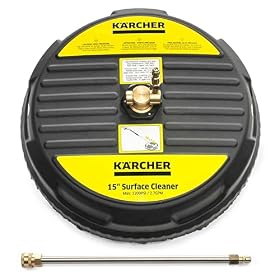 Kärcher Pressure Washer 15" Surface Cleaner Suitable for 2600 to 3200 PSIKÄRCHER
$64.99 as of
View on Amazon Dalmbox 16.5" Pressure Washer Surface Cleaner, 4-Wheel, 1/4” Quick ConnectDalmbox
$77.99 as of
View on Amazon VEVOR 16.5" Pressure Washer Surface Cleaner, Raised Handle, Stainless SteelVEVOR
$121.99 as of
View on Amazon
Product prices and availability are accurate as of the date/time indicated and are subject to change. Any price and availability information displayed on Amazon.com at the time of purchase will apply to the purchase of this product.
How to clean concrete with less risk
- Check the surface first. Look for flaking, loose patches, cracks, coatings, or exposed aggregate. Sweep away grit that could interfere with cleaning.
- Follow the washer and nozzle instructions. Choose a less aggressive, wider spray pattern where suitable. Do not assume a nozzle color or pressure setting is universal across machines.
- Test in a hidden area. Begin farther from the surface than you think you need to and use a steady, moving pass. Stop if the concrete lightens, roughens, or develops lines.
- Keep the wand moving evenly. Avoid aiming at one spot, and use consistent distance and speed. Do not use a narrow tip to chase stains or remove paint from concrete unless the surface and method are appropriate.
- Consider a surface cleaner for broad areas. Use an attachment compatible with the washer and follow its instructions. It can help produce more even passes, but it does not make excessive pressure safe.
- Use an appropriate cleaner when needed. For many stains, a suitable detergent and dwell time can reduce the need to increase pressure. Follow label directions and protect nearby plants and surfaces.
If the concrete is already etched
Stop washing the damaged area; more passes can deepen the marks. Rinsing may remove loose debris, but it will not replace stripped cement paste or restore exposed aggregate. For visible damage, decorative concrete, or a large area, ask a concrete repair professional about options. If the surface is only dirty and still intact, switch to a gentler method and test again elsewhere.
FAQ
Does a higher PSI pressure washer always damage concrete?
No. Damage depends on the concrete’s condition and the complete setup, including nozzle, distance, movement, and how long the stream hits one spot. High pressure leaves less margin for error, so test a gentle approach first.
Can a 25-degree or 40-degree nozzle etch concrete?
Yes. A wider fan is generally less concentrated than a pinpoint stream, but it can still etch concrete if used too close, too slowly, or on a weak surface. Follow the washer maker’s nozzle guidance and test first.
Will etched concrete go back to normal after it dries?
Usually not. If the surface paste has been removed and aggregate exposed, drying or rinsing will not restore it. Stop cleaning and consult a concrete repair professional if the damage is noticeable.