For a long concrete driveway, prioritize usable water flow, pump durability, hose reach, and surface-cleaner compatibility over the highest advertised PSI. A gas pressure washer is often a practical choice when you need extended runtime and do not want to manage electrical-cord limits.
A gas pressure washer for a long concrete driveway should provide enough water flow for efficient cleaning, support a compatible surface cleaner, and have a hose setup that reaches the far end without constant repositioning. For most residential concrete, the best choice is not necessarily the machine with the highest PSI; a balanced combination of PSI, GPM, runtime, and accessories is more useful.
What to look for first
Choose usable cleaning power, not maximum PSI alone
Pressure washers are commonly described by two numbers:
PSI (pounds per square inch): the force of the water.
GPM (gallons per minute): the amount of water delivered.
For a long concrete driveway, both matter. PSI helps break up embedded dirt, tire marks, and some organic growth, while GPM helps rinse debris away and lets you cover more area efficiently.
A residential gas washer in the general range of roughly 2,500 to 3,500 PSI and about 2.3 to 3.5 GPM is often a reasonable class to consider for driveway cleaning. Actual suitability depends on the concrete's condition, the machine's real operating output, and the accessories you use. Avoid selecting solely by the highest peak or maximum number on the box; operating pressure and flow are more useful for comparing machines.
Higher pressure is not automatically better. Excessive pressure, a close-held nozzle, or an unsuitable tip can etch concrete, remove loose material, damage expansion joints, or strip paint and coatings.
Make sure it can run a surface cleaner
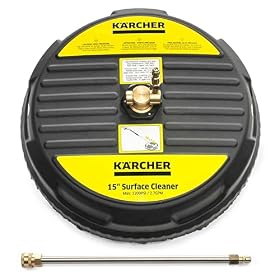
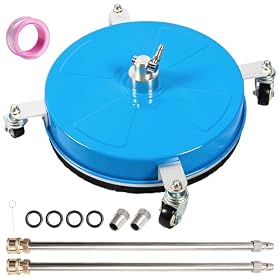
A surface cleaner is usually more practical than waving a spray wand over an entire long driveway. It uses rotating spray arms under a housing to clean a wider, more consistent path and can reduce visible streaking.
Check the surface cleaner's required PSI and GPM before buying the washer. A cleaner that needs more flow than the pressure washer can supply may spin poorly, leave stripes, or clean slowly. The manufacturer's compatibility guidance is more important than choosing the largest attachment available.
For a long driveway, a surface cleaner with a suitable cleaning width can reduce walking time, but an oversized attachment may perform poorly if the washer cannot maintain its required flow.
Features that matter on a long driveway
Gas power and runtime
Gas models are often a good fit when the job is far from an outlet or may take extended periods. They avoid extension-cord voltage-drop concerns and usually make it easier to move around a large property.
The tradeoffs are fuel, engine noise, exhaust, storage, and routine maintenance. Operate a gas pressure washer outdoors in a well-ventilated area, away from doors, windows, and air intakes. Never run it in a garage, enclosed porch, or other enclosed space, even with the door open.
Follow the engine and pump manufacturer's instructions for fuel, oil, starting, shutdown, and storage. If you expect only occasional small cleaning jobs, an electric unit may be simpler, but long-driveway work is one situation where gas power can be convenient.
Hose length and hose quality
A longer high-pressure hose can save time by reducing the need to move the machine. However, hose length should not be treated as a substitute for adequate water flow or a properly sized replacement hose.
Look for:
A hose rated for the washer's pressure and connection type.
Flexible construction that is manageable around vehicles and landscaping.
Fittings that match the pressure washer and spray gun.
Enough length to reach the working area while keeping the machine on a stable, level surface.
Do not connect an unapproved hose or fitting simply because it appears to fit. A high-pressure hose failure can cause injury or property damage.
Pump construction and serviceability
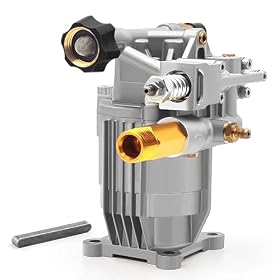
The pump is a key wear component. For a large recurring job, consider the manufacturer's information about pump materials, maintenance requirements, replacement-pump availability, and warranty coverage.
Do not assume that a more expensive pump specification automatically makes every machine better for your driveway. Service support and compatible replacement parts can matter more if the washer will be used regularly or stored for long periods.
Detergent application
Detergent can help with organic grime, grease, and some discoloration, but it is not a replacement for appropriate pressure and technique. A downstream injector or onboard detergent system may be convenient, but verify that the selected detergent is approved for the washer and the surface.
Use only a cleaner labeled for concrete and follow its dilution and dwell-time instructions. Keep detergent from drying on the driveway, vehicles, siding, and nearby plants. Rinse thoroughly and manage runoff according to local requirements.
Product prices and availability are accurate as of the date/time indicated and are subject to change. Any price and availability information displayed on Amazon.com at the time of purchase will apply to the purchase of this product.
Nozzle and technique recommendations
Use the nozzle recommended by the pressure-washer and surface-cleaner manufacturers. As a general safety rule, begin with a wider spray pattern and lower effective intensity, then increase cleaning power only if necessary.
Before cleaning the whole driveway:
Sweep away loose sand, leaves, and stones.
Test an inconspicuous area.
Keep the nozzle or surface cleaner moving at a steady pace.
Avoid holding a narrow spray close to the concrete for an extended time.
Keep the wand away from damaged joints, cracks, loose concrete, and deteriorated edges.
Rinse nearby walls, vehicles, and plants as needed to prevent residue or overspray damage.
A surface cleaner should generally be kept level and moved in overlapping passes. Do not stop in one spot while the spray arms are spinning.
Product prices and availability are accurate as of the date/time indicated and are subject to change. Any price and availability information displayed on Amazon.com at the time of purchase will apply to the purchase of this product.
Water supply and setup
A gas pressure washer still needs an adequate water supply. Before the cleaning day, confirm that the garden hose, faucet, inlet screen, and connections can provide the flow specified by the pressure-washer manufacturer.
Use a clean supply hose with the recommended diameter and fully open the faucet. Avoid kinks and restrictive quick-connect fittings. Turn on the water and squeeze the spray-gun trigger with the engine off, when the manufacturer's instructions allow, to purge trapped air before starting.
Never operate the pump without an adequate water supply. If the machine surges, pulses, or sounds abnormal, release the trigger, shut it down according to the instructions, and investigate the water supply and connections.
Product prices and availability are accurate as of the date/time indicated and are subject to change. Any price and availability information displayed on Amazon.com at the time of purchase will apply to the purchase of this product.
Is a gas pressure washer the right choice?
A gas unit is usually worth considering when:
The driveway is long or distant from a suitable electrical outlet.
You want longer uninterrupted cleaning sessions.
You plan to use a surface cleaner and other pressure-washer accessories.
You also need to clean patios, walkways, retaining walls, or other large areas.
A smaller electric model may be the better choice when storage, noise, emissions, and maintenance are more important than maximum mobility or runtime. For a single driveway, renting a suitable washer and surface cleaner may also make more sense than buying equipment that will rarely be used.
A practical buying checklist
Before choosing a gas pressure washer, verify:
Operating PSI and GPM, not just advertised peak figures.
Surface-cleaner compatibility and the attachment's required flow.
High-pressure hose length, rating, and connection type.
Pump warranty and availability of replacement parts.
Fuel, oil, maintenance, and winter-storage requirements.
Spray-gun and nozzle options included with the machine.
Whether the washer can be moved safely across your property.
Manufacturer guidance for concrete, detergent, and accessories.
If the driveway has fragile, crumbling, painted, sealed, or unusually old concrete, the surface condition should determine the cleaning approach. When damage is already present or the concrete's condition is uncertain, use a conservative setting and consider advice from a qualified concrete or cleaning professional.
FAQ
What PSI is best for washing a concrete driveway?
A gas pressure washer in the general range of roughly 2,500 to 3,500 PSI is often suitable for residential concrete, but operating pressure, GPM, nozzle choice, and technique all matter. Start conservatively and follow the concrete and pressure-washer manufacturer's guidance.
Is GPM or PSI more important for a long driveway?
Both are important. PSI provides impact for loosening grime, while GPM helps rinse and cover the driveway efficiently. For a long surface, adequate GPM and a compatible surface cleaner can make a noticeable difference in cleaning speed.
Do I need a surface cleaner for a long concrete driveway?
You do not strictly need one, but a compatible surface cleaner is usually easier to control over a large area and can help reduce wand marks and uneven stripes. Match its PSI and GPM requirements to the pressure washer.
Can high pressure damage a concrete driveway?
Yes. A narrow spray held too close, excessive pressure, or cleaning deteriorated concrete can cause etching, surface damage, or joint damage. Test a small area first, keep the spray moving, and use the least aggressive effective setting.
How long should the pressure-washer hose be for a long driveway?
Choose enough rated hose length to reach the working area without repeatedly moving the machine, while staying within the manufacturer's approved hose specifications. A longer hose does not compensate for inadequate water supply or incorrect fittings.