Electric and gas pressure washers can both clean patios, siding, vehicles, decks, and outdoor equipment, but they suit different working conditions. Electric models are usually the better fit for routine residential cleaning near a suitable outlet. Gas models make more sense when you need higher sustained output, longer reach without an extension cord, or the ability to work away from electrical power.
Choosing · Mon Sep 07
Electric versus gas pressure washers
Electric pressure washers are usually easier, quieter, and simpler for household cleaning, while gas models provide greater mobility and sustained power for large or demanding jobs. The right choice depends on the surfaces, water supply, runtime, and cleaning tasks you expect to handle.
What do you need help with?
Open an answer, or tell us what we should cover next.
Answered in this guide
Choose the right pressure washer type for your home
Choose electric for quieter, simpler occasional cleaning near an outdoor outlet. Choose gas for larger properties, longer sessions, heavier buildup, greater mobility, or locations without convenient electrical power.
Compare pressure washer power using PSI and GPM
PSI describes water pressure, while GPM describes water flow. Compare both specifications together to get a more useful picture of cleaning performance than PSI alone.
Match a pressure washer to the cleaning surface
Use lower pressure and careful technique for vehicles, painted surfaces, and other delicate materials. Concrete and masonry generally tolerate more power, while wood and composite decking need controlled cleaning.
Compare the practical tradeoffs of electric and gas models
Electric models are typically quieter and produce no exhaust at the point of use. Gas models offer more freedom from cords and can better suit extended or demanding outdoor cleaning.
Need something else?
Request a topic and help us choose what to build next.
Diagnose why a pressure washer runs without building pressure
Fix an electric pressure washer that trips a GFCI
Maintain a pressure washer between uses
Find replacement pump parts for a pressure washer
Requests help us prioritize the next guide. No email required.
One anonymous request per topic.
Electric versus gas pressure washers at a glance
| Consideration | Electric pressure washer | Gas pressure washer |
|---|---|---|
| Best for | Cars, patios, furniture, siding, and occasional home use | Large driveways, extensive decks, heavy buildup, and remote locations |
| Power source | Household electrical outlet | Gasoline engine |
| Setup | Usually quick and simple | Requires fuel, oil checks, and engine starting |
| Noise | Generally quieter | Generally louder |
| Maintenance | Lower routine maintenance | More engine and fuel maintenance |
| Mobility | Limited by outlet and cord length | Not tied to an electrical outlet, though it still needs a water source |
| Runtime | Limited by the electrical circuit and equipment duty cycle | Limited by fuel and manufacturer guidance |
| Indoor use | Not appropriate in wet indoor areas unless specifically allowed | Never use a gas engine indoors or in an enclosed space |
Electric option for household cleaning
 Westinghouse ePX3050 Electric Pressure Washer, 2100 Max PSI 1.76 Max GPM with Foam Cannon and…Westinghouse
$109.00 as of
View on Amazon Pressure Washer, Power Washer with 4 Quick Connect Nozzles 1 Foam Cannon, High Pressure Cleaning…LWQ
$119.98 as of
View on Amazon Greenworks 2100 PSI (1.2 GPM) Electric Pressure WasherGreenworks
$149.99 as of
View on Amazon
Product prices and availability are accurate as of the date/time indicated and are subject to change. Any price and availability information displayed on Amazon.com at the time of purchase will apply to the purchase of this product.
Choose an electric pressure washer when simplicity matters
An electric pressure washer is often the practical choice for homeowners who clean periodically and have an outdoor-rated electrical outlet within reach. It starts with the push of a switch or button, does not require gasoline storage, and generally produces less noise and exhaust than a gas machine.
Electric models are well suited to tasks such as:
- Washing cars and bicycles
- Cleaning outdoor furniture
- Removing ordinary dirt from siding
- Washing small or medium patios and walkways
- Cleaning decks with an appropriate pressure setting
- Rinsing lawn equipment and tools
The main limitation is access to power. You may need a heavy-duty, outdoor-rated extension cord if the manufacturer permits one, but an extension cord can cause voltage drop when it is too long, too light, or used with other loads. Follow the pressure washer manual and electrical-safety guidance rather than assuming any household cord is suitable.
Electric machines are also not automatically gentle. A narrow spray pattern held too close can damage paint, wood, mortar, vinyl, or seals. Use the widest suitable nozzle first, keep the wand moving, and increase cleaning intensity gradually.
Gas option for large outdoor jobs
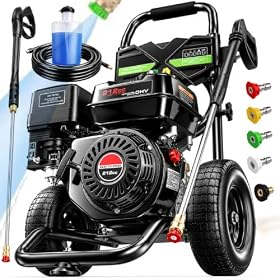 4200 PSI 4.0 GPM Gas Pressure Washer, 212cc Heavy Duty Power Washer, Commercial Gas Powered…IvyBess
$308.99 as of
View on Amazon 4200PSI 4.0GPM Gas Pressure Washer, Heavy Duty Power Washer, Commercial Gas Powered Pressure Washer for…Steupoek
$399.99 as of
View on Amazon- Westinghouse ePX3050 Electric Pressure Washer, 2100 Max PSI 1.76 Max GPM with Foam Cannon and…Westinghouse
$109.00 as of
View on Amazon
Product prices and availability are accurate as of the date/time indicated and are subject to change. Any price and availability information displayed on Amazon.com at the time of purchase will apply to the purchase of this product.
Choose a gas pressure washer when output and mobility matter
A gas pressure washer can be more useful for large properties, long cleaning sessions, and areas where an electrical outlet is unavailable. The engine gives the machine independent power, so you are not managing a power cord across a driveway or yard.
Gas models are commonly considered for:
- Large concrete driveways and walkways
- Extensive decks, fences, or retaining walls
- Heavy dirt, mud, and some forms of outdoor buildup
- Construction cleanup and property maintenance
- Jobs far from a suitable electrical outlet
Gas equipment typically requires more preparation. You may need to check fuel, engine oil, air filtration, and storage procedures. Fuel that sits too long can create starting and carburetor problems, so follow the manufacturer’s storage instructions. Gas exhaust also makes these machines unsuitable for garages, sheds, porches with poor ventilation, or other enclosed spaces.
More power does not remove the need for correct technique. High output can strip paint, etch concrete, gouge soft wood, and force water behind siding or into electrical components.
Longer reach from the machine
 Simpson Cleaning 40224 Morflex Series 3300 PSI Pressure Washer Hose, Cold Water Use, Inner Diameter,…SIMPSON
$25.71 as of
View on Amazon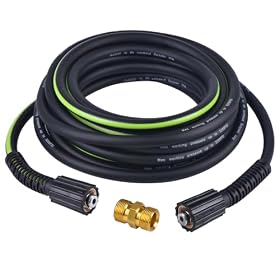 RainBello Pressure Washer Hose 1/4" × 25FT - 3200 PSI Heavy Duty Power Washer Hose…RainBello
$17.99 as of
View on Amazon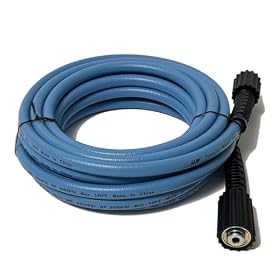 LULUW 25FT 1/4-inch High Pressure Washer Hose,3600PSI M22 14mm Replacement Power Washer Hose for Most…LULUW
$15.99 as of
View on Amazon
Product prices and availability are accurate as of the date/time indicated and are subject to change. Any price and availability information displayed on Amazon.com at the time of purchase will apply to the purchase of this product.
Compare cleaning power correctly: PSI and GPM
Two specifications matter most when comparing pressure washers:
- PSI, or pounds per square inch, describes water pressure.
- GPM, or gallons per minute, describes water flow.
PSI affects the force at the spray tip. GPM affects how much water moves across the surface and how quickly loosened dirt is rinsed away. A machine with a higher PSI number is not automatically the fastest or safest option for every job.
Some manufacturers also present a cleaning-power figure based on PSI multiplied by GPM. Treat that number as a comparison aid, not a guarantee of real-world cleaning speed. Nozzle design, hose length, water supply, surface condition, detergent use, and operator technique also matter.
When choosing between electric and gas equipment, compare the rated or working specifications when available, not only a maximum or peak figure. Read the manual or product label carefully because manufacturers may describe these measurements differently.
More even cleaning on flat surfaces
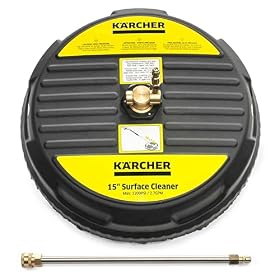 Kärcher Pressure Washer 15" Surface Cleaner Suitable for 2600 to 3200 PSIKÄRCHER
$64.99 as of
View on Amazon Dalmbox 16.5" Pressure Washer Surface Cleaner, 4-Wheel, 1/4” Quick ConnectDalmbox
$89.99 as of
View on Amazon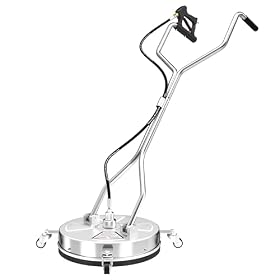 ZMRTDWO 18" Dual Handle Pressure Washer Surface Cleaner with 4 Wheels, 4000 PSI Max Stainless…ZMRTDWO
$189.99 as of
View on Amazon
Product prices and availability are accurate as of the date/time indicated and are subject to change. Any price and availability information displayed on Amazon.com at the time of purchase will apply to the purchase of this product.
Match the machine to the surface
The surface should determine the pressure and technique—not the other way around.
Vehicles and delicate surfaces
An electric pressure washer is usually easier to control for cars, motorcycles, painted surfaces, and outdoor furniture. Use a wider spray pattern, keep adequate distance, and avoid spraying directly into wheel bearings, electrical connectors, window seals, or damaged paint.
Concrete and masonry
Concrete often tolerates more cleaning force than painted or wooden surfaces, but excessive pressure can leave visible marks or expose aggregate. For broad flat areas, a compatible surface cleaner may produce more even results than a concentrated wand spray.
Wood and composite decking
Wood can be damaged by a narrow jet, excessive pressure, or lingering in one spot. Start conservatively and follow the decking manufacturer’s recommendations. Composite materials also vary, so do not assume they can tolerate the same treatment as concrete.
Siding and painted surfaces
Use a lower-intensity approach and avoid driving water behind siding, around windows, or into vents. A detergent designed for pressure-washer use may loosen dirt before rinsing, reducing the need for aggressive pressure.
Consider the full operating cost
The purchase price is only one part of the decision.
Electric operating considerations
Electric models generally avoid gasoline and engine-oil costs, but you may need a suitable extension cord, outdoor-rated outlet, ground-fault protection, or a longer pressure hose. Never defeat electrical safety devices or use damaged cords near water.
Gas operating considerations
Gas models require fuel and periodic engine maintenance. Storage can also require fuel stabilizer, draining, or other steps specified by the manufacturer. If the washer will be used only a few times each year, this maintenance burden may outweigh the benefit of engine power.
Water supply
Both types need an adequate water source. A pressure washer is not a substitute for a water supply, and a weak garden-hose flow can limit performance or contribute to pump problems. Check the manufacturer’s inlet requirements and never run a pump dry unless the instructions specifically allow it.
Portability is more than the power source
A gas pressure washer is independent of an electrical outlet, but it can be heavier and harder to move. An electric unit may be lighter, yet its cord can restrict movement. In either case, consider:
- The distance from the water source
- The distance from the electrical outlet, if applicable
- Hose and cord storage
- Wheel and handle design
- Whether the machine must be lifted into a vehicle
- The availability of safe, level operating space
For many home jobs, a longer pressure hose is more convenient than moving the machine repeatedly. Use only hoses and fittings rated for pressure-washer service and compatible with the machine.
Noise, fumes, and neighborhood impact
Electric pressure washers are generally quieter and produce no exhaust at the point of use. That can matter around homes, enclosed courtyards, neighbors, and noise-sensitive areas. Gas models produce engine noise and exhaust, so they require more careful placement and ventilation.
Regardless of type, avoid directing spray toward people, animals, windows, electrical equipment, or traffic. Wear eye protection and suitable footwear, and follow the machine’s safety instructions.
Which type should you buy?
Choose an electric pressure washer if you:
- Clean occasionally or seasonally
- Have a suitable outdoor electrical outlet
- Mostly wash vehicles, furniture, siding, patios, or small walkways
- Prefer lower noise and simpler maintenance
- Do not need to work far from a power source
Choose a gas pressure washer if you:
- Regularly clean large areas
- Need sustained output for demanding outdoor work
- Work away from electrical outlets
- Are prepared to maintain an engine and manage fuel
- Can operate the machine outdoors with adequate ventilation
If you are uncertain, avoid choosing by the highest PSI number alone. Estimate the largest surface you will clean, identify the most delicate surface you must protect, check your water and power access, and then select the least aggressive machine that can complete the work efficiently.
Before operating either type
- Read the manufacturer’s manual, including nozzle and detergent instructions.
- Inspect the hose, gun, wand, fittings, cord, and fuel system for damage.
- Confirm that the water supply is connected before starting the pump.
- Test the spray on an inconspicuous area.
- Begin with the widest suitable spray pattern and lower pressure.
- Keep the wand moving instead of concentrating spray in one spot.
- Shut down and depressurize the system before changing accessories.
- Store the unit according to the manufacturer’s instructions.
If a pressure washer trips breakers, leaks fuel, emits unusual smoke, runs erratically, or loses pressure despite a clear water path and clean filter, stop using it. Electrical faults, fuel-system repairs, and pump repairs may require a qualified technician.
FAQ
Is an electric pressure washer powerful enough to clean concrete?
Many electric models can handle ordinary dirt on smaller concrete areas, but the result depends on the machine’s working PSI and GPM, the surface condition, and the nozzle. Large or heavily soiled areas may be faster with a higher-output machine or a compatible surface cleaner.
Are gas pressure washers always more powerful than electric models?
Gas models often offer higher sustained output and greater mobility, but specifications vary. Compare working PSI, GPM, nozzle options, and the manufacturer’s intended use rather than assuming power from the fuel type alone.
Can I use an extension cord with an electric pressure washer?
Only if the manufacturer permits it and the cord is suitable for the machine, outdoor use, and the distance involved. An undersized or excessively long cord can create voltage drop and overheating. Use ground-fault protection as required and keep electrical connections away from water.
Which pressure washer is easier to maintain?
Electric models generally require less routine maintenance because they do not have an engine, fuel system, or engine oil. They still need inspection of hoses, fittings, filters, cords, and pump components. Gas models require additional fuel and engine maintenance according to the manual.
Can I use a gas pressure washer in a garage with the door open?
No. Gas engines produce carbon monoxide and should not be operated in garages, sheds, or other enclosed or partly enclosed spaces. Operate them outdoors in a well-ventilated area and follow the manufacturer’s safety instructions.