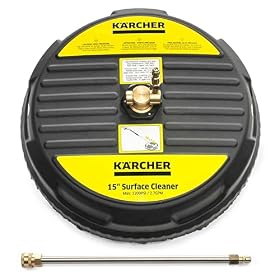
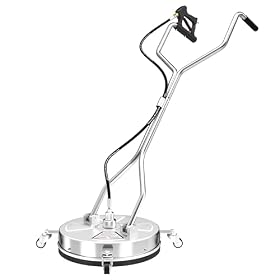
A pressure washer surface cleaner can clean flat areas faster and with fewer streaks than a spray wand. Match its pressure and flow requirements to your machine, then choose the right size and connector for the surface you plan to clean.
Surface cleaner for a pressure washer
A surface cleaner is a round attachment that connects to a pressure washer wand or hose and uses rotating spray nozzles beneath a housing. It is designed for flat surfaces such as concrete driveways, patios, sidewalks, garage floors, and decks. Compared with cleaning a large area with a single spray nozzle, a surface cleaner can make overlapping passes more evenly and help reduce visible striping.
The most important buying rule is compatibility: match the cleaner’s required PSI, GPM, connection, and surface rating to your pressure washer and the material you want to clean.
What to check before buying
1. Match both PSI and GPM
Pressure washer attachments are rated for a specific pressure range and water flow. Check your pressure washer’s actual operating specifications—not only its maximum advertised PSI—and compare them with the surface cleaner’s requirements.
PSI affects the force available to remove dirt.
GPM affects how much water reaches the rotating bar and how quickly it can rinse debris away.
A machine that meets the PSI rating but falls short on GPM may make the cleaner rotate poorly or clean slowly.
Exceeding the attachment’s maximum rating can damage the swivel, spray bar, or housing and creates a safety risk.
If the surface cleaner lists a required or recommended GPM range, treat that specification as just as important as PSI. When the manufacturer provides a compatibility chart, use it instead of guessing.
2. Confirm the connector
Surface cleaners commonly connect through a quick-connect fitting, but the fitting size and configuration can vary. Before ordering, identify:
The quick-connect size on your pressure washer wand or hose
Whether the attachment connects to a wand, lance, or trigger-gun outlet
Whether an adapter is required
Whether the included adapter is rated for your machine’s pressure
Do not force a fitting that does not match. A loose or improvised connection can leak or separate under pressure. Use only compatible, pressure-rated adapters and follow the pressure washer manufacturer’s instructions.
3. Choose a size suited to the machine
A wider cleaner can cover more area per pass, but it also requires enough water flow to keep the spray bar spinning effectively. A smaller unit may be a better match for a compact electric pressure washer, while a larger cleaner may be more practical with a higher-flow machine.
Choose based on the washer’s available GPM and the area you need to clean—not simply the largest diameter available. If the cleaner spins slowly, leaves dirty bands, or requires repeated passes, it may be too large for the pressure washer or may have a blockage or worn component.
4. Consider the surface
Most pressure washer surface cleaners are intended for hard, relatively flat surfaces. Concrete, sealed masonry, and some pavers are common applications, but the correct pressure still depends on the material and its condition.
Use extra care with:
Painted or coated concrete
Older or crumbling concrete
Unsealed natural stone
Soft brick or mortar joints
Wood decking and composite decking
Surfaces with loose aggregate or damaged sections
A surface cleaner does not eliminate the risk of damage. Start in an inconspicuous area, keep the unit moving, and use the lowest effective pressure. For wood, siding, delicate coatings, and uneven surfaces, a wand with the appropriate nozzle and technique may be safer than a flat-surface cleaner.
Why use a surface cleaner instead of a spray nozzle?
A spray wand concentrates water into a narrow cleaning path. On a large slab, that can produce stripes if the distance, angle, or speed changes between passes. A surface cleaner keeps rotating jets at a more consistent height inside its housing and covers a wider path.
It can also help contain some overspray, although water and loosened dirt can still escape around the edges. You should still protect nearby doors, walls, vehicles, plants, and electrical equipment.
A surface cleaner is usually most useful when you need to clean a broad, flat area. It is less useful for stairs, vertical walls, corners, narrow edges, irregular stone, and heavily uneven surfaces.
Product prices and availability are accurate as of the date/time indicated and are subject to change. Any price and availability information displayed on Amazon.com at the time of purchase will apply to the purchase of this product.
Features that can affect the buying decision
Swivel and spray-bar construction
The internal swivel allows the spray bar to rotate. Look for a replacement-swivel or maintenance path if the manufacturer supports one. The spray bar should be protected by the housing, and the nozzles should be serviceable or replaceable when possible.
A damaged swivel can cause vibration, slow rotation, or uneven cleaning. If the attachment is not designed for user service, do not disassemble a pressurized component unless the instructions specifically allow it.
Wheels or a skirt
Wheels can make a larger cleaner easier to move across a slab, while a skirt can help contain spray. Wheels may be less convenient on rough or uneven surfaces, where the housing can catch or bounce.
A cleaner that drags, tilts, or rocks can leave inconsistent results. Keep it level and avoid pushing it across raised cracks or debris.
Wand or hose connection
A wand-connected cleaner is convenient for occasional driveway and patio work. A hose-connected model may be easier to control in some setups, but it must be compatible with the pressure washer’s gun, hose, and fitting system.
Consider the total weight when connected. A wide cleaner can become tiring if you must hold it at the end of a long wand, especially on vertical or sloped work.
Replacement parts
Nozzles, swivels, O-rings, fittings, and wheels can wear out. Before buying, check whether the manufacturer lists replacement parts for the attachment. A low-cost cleaner that cannot be repaired may be reasonable for occasional use, but replaceable wear parts can matter if you clean frequently.
Large surface cleaner for high-flow pressure washers
Product prices and availability are accurate as of the date/time indicated and are subject to change. Any price and availability information displayed on Amazon.com at the time of purchase will apply to the purchase of this product.
How to use a pressure washer surface cleaner
Remove loose dirt, leaves, gravel, and other debris from the area.
Connect the cleaner with the pressure washer turned off and depressurized.
Verify that the cleaner’s PSI and GPM ratings match the machine.
Start in a low-visibility area to check for surface damage and cleaning marks.
Keep the cleaner flat and move at a steady walking pace.
Overlap each pass slightly rather than leaving gaps between paths.
Avoid stopping in one spot while the trigger is engaged.
Use a wand or appropriate nozzle for edges, corners, steps, and stubborn spots.
Shut down and depressurize the system before inspecting or clearing the attachment.
Rinse the cleaner and store it according to the manufacturer’s instructions.
Never put your hands near the rotating bar or nozzles while the pressure washer is connected or pressurized. Wear eye protection and suitable footwear, and keep other people away from the cleaning area.
Product prices and availability are accurate as of the date/time indicated and are subject to change. Any price and availability information displayed on Amazon.com at the time of purchase will apply to the purchase of this product.
Troubleshooting uneven cleaning or slow rotation
The cleaner leaves stripes
Check that the housing is level and that you are moving at a steady speed. Overlap passes slightly. If the stripes continue, inspect the nozzles for blockage and confirm that the pressure washer supplies the required GPM.
The spray bar rotates slowly or stops
Turn off the pressure washer, disconnect the water supply, and release pressure before inspecting the unit. Check for debris in the nozzles, a kinked hose, a partially open trigger, or an inlet screen blockage if the design includes one.
If the nozzles are clear, compare the washer’s flow specification with the cleaner’s minimum requirement. A worn swivel may need replacement. Do not lubricate or replace parts unless the manufacturer specifies the correct procedure and part.
The cleaner vibrates or wobbles
Stop using it and inspect the spray bar, nozzles, housing, wheels, and connection. A missing nozzle, damaged spray bar, loose component, or failing swivel can create dangerous vibration. Replace the damaged part or attachment before continuing.
Water leaks at the connection
Depressurize the system and inspect the O-ring, quick-connect fitting, and adapter. Replace a damaged seal with the correct pressure-rated part. If the fitting does not seat securely, stop using the cleaner rather than relying on tape or an improvised adapter.
Product prices and availability are accurate as of the date/time indicated and are subject to change. Any price and availability information displayed on Amazon.com at the time of purchase will apply to the purchase of this product.
When a different attachment is the better choice
A surface cleaner is not a universal pressure washer accessory. Use a wand and suitable nozzle when you need to clean vertical surfaces, narrow gaps, corners, furniture, siding, or delicate materials. A turbo nozzle may help with isolated stubborn spots, but it requires careful distance and movement because it concentrates considerable cleaning force.
For a large commercial area, frequent use, or difficult buildup, choose a surface cleaner specifically rated for the pressure washer and job. If the pressure washer cannot meet the cleaner’s flow requirement, upgrading the attachment alone will not solve the problem; a smaller compatible cleaner or a higher-flow pressure washer may be the sensible choice.
Bottom line
Choose a surface cleaner by checking PSI, GPM, connector type, diameter, and surface compatibility in that order. A properly matched cleaner should move smoothly, rotate consistently, and make flat-surface cleaning more uniform than working with a narrow spray nozzle. Start gently on any surface that could be damaged, and replace a cleaner with a damaged swivel, spray bar, or connection rather than continuing to use it.
FAQ
Can any surface cleaner be used with any pressure washer?
No. The cleaner must be compatible with the pressure washer’s PSI, GPM, connector, and sometimes its wand or hose configuration. Check the manufacturer’s specifications before connecting it.
What size surface cleaner should I buy?
Choose a diameter that your pressure washer can supply adequately. Larger cleaners cover more area, but they generally need enough water flow to keep the spray bar rotating and cleaning effectively.
Can a surface cleaner damage concrete?
Yes. Excessive pressure, a damaged nozzle, stopping in one place, or cleaning deteriorated concrete can cause marks or surface damage. Test an inconspicuous area first and use the lowest effective pressure.
Why is my pressure washer surface cleaner not spinning?
Common causes include clogged nozzles, insufficient water flow, a kinked hose, an obstructed inlet, or a worn swivel. Turn off and depressurize the system before checking anything, and follow the manufacturer’s service instructions.