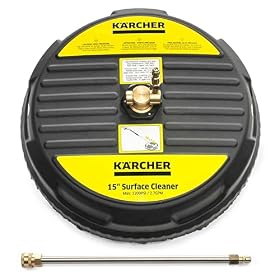
A pressure washer surface cleaner can clean a driveway faster and more evenly than a wand, but only if its inlet, pressure rating, size, and nozzle setup match your pressure washer.
A surface cleaner attachment is usually the best pressure washer accessory for cleaning a driveway because its enclosed spray bar cleans a wider area and helps reduce visible streaks. The important part is matching the cleaner to your pressure washer’s PSI, GPM, connection, and surface. A cleaner that is too large for the machine may move slowly and leave dirt behind, while excessive pressure or a damaged concrete surface can cause etching and other damage.
What to check before buying
Match the pressure and water flow
Check the pressure washer’s rated PSI and GPM in the owner’s manual or on its data plate. Then compare those figures with the surface cleaner manufacturer’s required or supported range.
PSI affects the force available to remove stuck-on dirt.
GPM affects how quickly the cleaner can flush away loosened soil and how fast it can cover an area.
A surface cleaner’s pressure rating is a maximum or compatibility limit, not a recommendation to use more pressure than the driveway can safely handle.
A common mistake is choosing a large cleaner for a low-flow electric pressure washer. The cleaner may still connect, but the spray bar can rotate poorly and cleaning can be slow. When in doubt, follow the manufacturer’s recommended cleaner diameter for your machine’s actual working pressure and flow—not just its advertised maximum PSI.
Choose a practical cleaning width
A wider surface cleaner covers more driveway per pass, but it also requires enough water flow to maintain effective nozzle performance. A smaller attachment may be a better match for a compact electric pressure washer, narrow walkways, steps, or areas with stubborn buildup.
For a residential driveway, prioritize compatibility and consistent rotation over the largest available cleaning width. A cleaner that maintains steady spray-bar rotation will generally produce a more uniform result than an oversized attachment that struggles to keep up.
Confirm the connection
Pressure washer accessories may use different quick-connect arrangements. Check all of the following before ordering:
The inlet connection size and type
Whether your wand or spray gun accepts the attachment directly
Whether an adapter is required
Whether the included plug or fitting matches your pressure washer hose or gun
Do not force a fitting or rely on a loose connection. Shut off the machine and release pressure before changing accessories, following the pressure washer’s instructions.
Look for adjustable height or durable casters
Adjustable height can help keep the spray bar at a suitable distance from the driveway. Casters make long passes easier and help maintain a more consistent cleaning height. A skirt or splash guard can also reduce overspray, although it will not eliminate all water and debris escaping around the housing.
For occasional home use, simple construction may be sufficient. For frequent cleaning, consider the quality of the swivel, wheels, spray-bar assembly, and replacement nozzle availability. A clogged or worn nozzle can make the cleaner rotate unevenly and leave stripes.
Is a surface cleaner safe for a concrete driveway?
It can be, but concrete condition matters. A surface cleaner concentrates multiple jets over a controlled area, so it is not automatically safe for every driveway.
Use extra caution if the concrete is:
Cracked, flaking, or spalled
Freshly installed or recently repaired
Decorative, painted, sealed, or coated
Soft, weathered, or already losing its surface
Made from pavers with loose joint material
Start in an inconspicuous area using the lowest effective pressure and a slow, controlled pass. Keep the cleaner moving rather than stopping over one spot. If the surface coating lifts, the concrete changes color sharply, or aggregate begins to loosen, stop and reassess.
For painted, sealed, or specialty surfaces, consult the coating or concrete manufacturer before pressure washing. When damage is possible, a qualified professional may be the safer choice.
Product prices and availability are accurate as of the date/time indicated and are subject to change. Any price and availability information displayed on Amazon.com at the time of purchase will apply to the purchase of this product.
How to use a surface cleaner on a driveway
Remove loose debris. Sweep away gravel, leaves, sticks, and other material that could clog the nozzles or be thrown from beneath the housing.
Pre-rinse the area. Use the pressure washer wand to wet the driveway and loosen surface dirt.
Apply detergent only if appropriate. Use a pressure-washer-approved detergent and follow the machine and detergent instructions. Allow it to dwell without letting it dry.
Connect the surface cleaner with the machine off and depressurized. Check that the fittings are fully seated.
Begin with a test pass. Use overlapping, straight passes at a consistent walking speed.
Avoid stopping in place. A stationary spray bar can leave a circular mark or clean one area more aggressively.
Rinse afterward. Remove loosened dirt and detergent with the wand or the surface cleaner, as appropriate.
Inspect after drying. Some stains, rust marks, oil, and biological growth may require a suitable pretreatment rather than more pressure.
Keep people, pets, vehicles, and fragile objects away from the work area. Wear eye protection and suitable footwear, and never point the spray toward a person or animal.
Product prices and availability are accurate as of the date/time indicated and are subject to change. Any price and availability information displayed on Amazon.com at the time of purchase will apply to the purchase of this product.
Why does a surface cleaner leave stripes?
Striping or circular marks usually indicate inconsistent nozzle rotation or inconsistent movement. Check these causes in order:
1. Clogged or damaged nozzles
Turn off the pressure washer, disconnect the water supply if required by the manual, and release trapped pressure. Inspect the spray-bar nozzles for grit or blockage. Clean them only with the method recommended by the surface cleaner manufacturer; do not enlarge an orifice with a drill or other improvised tool.
Replace a nozzle if it is visibly damaged, worn, or still produces an uneven spray after cleaning.
2. Debris in the swivel
Sand or dirt in the swivel can make the bar rotate slowly, stop, or wobble. Inspect and service the swivel according to the instructions. Do not disassemble a pressurized attachment.
3. Poor pressure or water flow
Verify that the water supply is fully open, the inlet screen is clean, and the hose is not kinked. A partially closed faucet, clogged filter, undersized supply hose, or pressure washer problem can reduce flow enough to affect rotation.
4. Moving too slowly or stopping
Keep the cleaner moving at a steady pace with slightly overlapping passes. If marks remain, try a faster or slower pace in a test area rather than repeatedly covering the entire driveway.
If the bar will not rotate after the nozzles, water supply, and swivel have been checked, a replacement swivel, nozzle set, or surface cleaner may be more practical than further repair. Follow the manufacturer’s parts guidance.
Product prices and availability are accurate as of the date/time indicated and are subject to change. Any price and availability information displayed on Amazon.com at the time of purchase will apply to the purchase of this product.
Do you need detergent?
Not always. Water and mechanical cleaning may be enough for ordinary soil, dust, and loose grime. Detergent can help with organic buildup, mildew, grease, or embedded soil, but it must be compatible with the pressure washer and the driveway surface.
Detergent will not solve every stain. Rust, oil, efflorescence, and paint may need specialized treatment. Avoid mixing chemicals unless the product instructions specifically allow it, and prevent runoff from entering storm drains or planted areas where applicable.
Surface cleaner versus a pressure washer wand
A surface cleaner is generally preferable for broad, flat driveway areas because it helps maintain a consistent distance and reduces wand fatigue. A wand remains useful for:
Do not use a turbo nozzle or narrow high-pressure nozzle as a substitute for careful technique on vulnerable concrete. Narrow jets can etch surfaces more readily when held too close or kept in one place.
When should you replace the attachment?
A replacement nozzle or swivel may be reasonable when the housing and frame are sound but the spray pattern or rotation is poor. Replace the complete attachment when the deck is cracked, the wheels no longer track safely, the swivel leaks significantly, or compatible replacement parts are unavailable.
If the pressure washer cannot supply the surface cleaner’s minimum water flow, buying a different attachment may not fix the problem. In that situation, use a smaller compatible cleaner or consider whether the pressure washer itself is suitable for driveway cleaning. For electrical faults, damaged hoses, or pump problems, disconnect the machine and follow the manufacturer’s service guidance or contact a qualified repair professional.
FAQ
What size surface cleaner is best for a driveway?
Choose a size that matches your pressure washer’s actual working PSI and GPM. A larger cleaner is not automatically better; if the machine cannot maintain the required flow, the spray bar may rotate poorly and leave streaks.
Can I use a surface cleaner on a concrete driveway?
Usually, but inspect the concrete first and begin with a cautious test pass. Cracked, spalled, coated, decorative, or recently installed concrete may be damaged by pressure washing and may require manufacturer guidance or professional service.
Why is my surface cleaner not spinning?
Check for clogged or damaged nozzles, debris in the swivel, low water flow, a kinked hose, or an undersized pressure washer. Shut off and depressurize the equipment before inspecting the attachment.
Should I use detergent with a driveway surface cleaner?
Detergent is optional and depends on the type of dirt and the driveway material. Use only a compatible pressure-washer detergent, follow its instructions, and do not let it dry on the surface.
Can a surface cleaner remove oil stains from a driveway?
Pressure washing may loosen some oil, but old or deep oil stains often require a suitable pretreatment. More pressure alone can damage concrete without fully removing the stain.