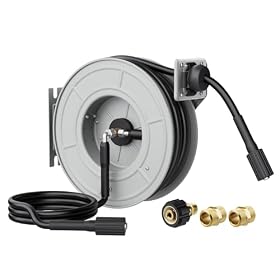
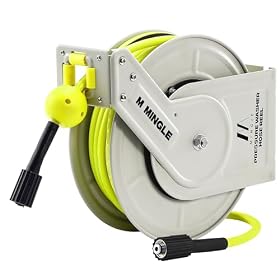
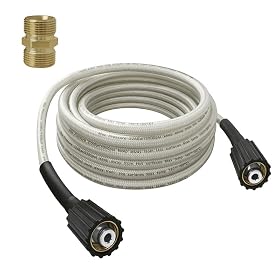
The best hose reel for a pressure washer is not simply the one with the longest capacity. Look for a reel rated for your washer’s working pressure, sized for the hose diameter and length, with a smooth guide path, swivel connection, and enough bend radius to prevent sharp folds.
A hose reel that does not kink a high-pressure hose needs more than a sturdy drum. It must match the hose’s pressure rating and diameter, provide a generous bend radius, and let the hose unwind without twisting at the connection. A swivel inlet, smooth hose guide, and correct mounting position also make a major difference.
No reel can prevent kinks if the hose is stored tightly, dragged around corners, or forced into a bend sharper than the hose allows. Use the following specifications to choose a reel that reduces kinking without restricting water flow or creating a safety problem.
What to look for in a pressure washer hose reel
1. Match the pressure and temperature ratings
Choose a reel and included fittings rated at or above the pressure and water temperature produced by your pressure washer. Check the pressure washer manual and the hose label rather than relying only on the reel’s advertised capacity.
The lowest-rated component controls the safe working limit. This includes:
The hose
Reel body and drum
Swivel inlet
High-pressure fittings
Quick-connect adapters
Any extension or coupler
Do not use a standard garden-hose reel for a high-pressure hose unless the manufacturer specifically rates it for pressure-washer use. A garden-hose reel may have the wrong fittings, seals, flow path, or pressure rating.
2. Check hose diameter and reel capacity
The reel must be designed for the hose’s outside diameter, not just its length. A reel that holds a certain length of a narrow hose may not hold the same length of a thicker hose.
Capacity listings can also be optimistic when they do not clearly state the hose diameter used for the measurement. If you are replacing an existing hose, compare its diameter with the reel’s specifications before ordering.
Avoid packing more hose onto the reel than it is designed to hold. Overfilling can cause the outer layers to slip off the sides, increase drag, and force the hose into tight bends.
3. Prioritize a large, smooth bend radius
Kinks usually form when a hose is bent sharply near the reel inlet, outlet, spray gun, or pressure washer. A larger drum and a smoothly shaped hose path reduce this problem.
Look for:
A wide drum rather than a narrow spool
Rounded reel edges
A hose guide or fairlead
A low-friction outlet path
Room for the hose to leave the reel without an immediate sharp turn
The hose’s own minimum bend radius is important. If the hose manufacturer lists one, the reel should allow at least that much curvature. Do not assume that a compact reel is better simply because it saves space; very small drums often create tighter bends.
4. Choose a reel with a swivel inlet
A swivel inlet allows the connection to rotate as the reel moves or the hose is pulled. This helps prevent twisting at the pressure washer or fixed water connection.
A swivel does not correct a kinked hose by itself. It is most useful when combined with a properly routed hose and a reel that is firmly mounted. Check that the swivel is rated for the pressure and temperature of the system and uses compatible thread or quick-connect fittings.
5. Consider manual versus retractable designs
A manual reel is often the simpler choice for a high-pressure hose. You can guide the hose onto the drum row by row, which helps prevent overlapping loops and tight bends. It also has fewer moving parts.
A retractable reel is convenient, but the retraction mechanism must be strong enough for the hose and should include a controlled guide. If the hose snaps back, winds unevenly, or enters the reel at an angle, it can develop kinks despite the automatic storage feature.
For either design, look for a mechanism that lets you control winding speed and stop the hose from piling up on one side.
Mounting position matters
Install the reel where the hose can leave the drum in a mostly straight line. A reel mounted too close to a wall, corner, or pressure washer can make the first few feet of hose bend sharply.
Before mounting, check:
The hose outlet direction when the reel is full and nearly empty.
Whether the reel can swivel or needs a fixed position.
Clearance for the handle, crank, or retracting hose.
Access to the water inlet and pressure washer connection.
Whether the mounting surface can support the reel and a pulled hose.
Use the mounting hardware and surface requirements specified by the reel manufacturer. A loose mount can cause the hose to twist, pull fittings sideways, or damage the wall or support structure.
Product prices and availability are accurate as of the date/time indicated and are subject to change. Any price and availability information displayed on Amazon.com at the time of purchase will apply to the purchase of this product.
Features that help prevent kinks
Hose guide or fairlead
A guide keeps the hose aligned as it winds and unwinds. It is especially useful on a reel that does not swivel or on installations where the hose approaches from the side.
Level-wind mechanism
A level-wind system moves the hose across the drum instead of allowing it to form a pile in one spot. This can reduce crushing and overlapping, but it still requires the correct hose diameter and capacity.
Wide drum and side flanges
The drum should be wide enough for the hose to curve gradually. Side flanges should retain the hose without pinching it against sharp edges.
Flexible whip hose
A short, flexible connection between the reel and pressure washer can reduce stress at the reel inlet. It must still be a pressure-rated component with compatible fittings. Do not substitute a regular low-pressure hose.
Locking or controlled-retraction mechanism
A lock prevents the reel from unwinding when the hose is stored. On retractable models, controlled retraction helps keep the hose from snapping back or winding unevenly.
Product prices and availability are accurate as of the date/time indicated and are subject to change. Any price and availability information displayed on Amazon.com at the time of purchase will apply to the purchase of this product.
Common reasons a hose reel still kinks
Even a suitable reel can kink when the hose is handled incorrectly.
The hose is pulled sideways: Move the reel or use a guide so the hose leaves the drum in line with the pull.
The hose is wound while twisted: Lay the hose out straight and remove loops before rewinding.
The drum is overfilled: Remove excess hose or use a reel with greater capacity.
The hose is wound under pressure: Turn off the pressure washer, shut off the water supply, and relieve pressure according to the manufacturer’s instructions before storing.
The hose is dirty or wet: Rinse off grit and allow the hose to drain before winding. Dirt can increase drag and damage the outer cover.
The hose is too stiff for the reel: Cold temperatures, a heavy hose construction, or age can make tight storage bends more likely.
The reel is mounted too close to an obstacle: Reposition it or add a properly rated guide rather than forcing the hose around a corner.
Never try to straighten a pressurized hose by sharply pulling or stepping on it. Stop the machine, disconnect or depressurize the system as directed by the manual, and inspect the hose for cuts, bulges, exposed reinforcement, or damaged fittings.
Product prices and availability are accurate as of the date/time indicated and are subject to change. Any price and availability information displayed on Amazon.com at the time of purchase will apply to the purchase of this product.
When a hose reel is not the right solution
A reel may not solve repeated kinking if the hose itself has been permanently damaged. Replace the hose when it has deep flat spots, exposed reinforcement, bulges, cracking, leaking, or fittings that no longer seal correctly.
If the existing hose is unusually stiff or much larger than the reel’s intended size, replacing the reel and hose as a matched set may be more practical. Replace the reel when the drum is cracked, the frame is bent, the swivel leaks, the winding mechanism binds, or the mounting point can no longer hold it securely.
For high-pressure equipment, follow the pressure washer, hose, and reel manufacturers’ instructions. If a connection leaks at high pressure or a component’s rating is unclear, stop using it and have the setup checked or replaced rather than adapting it with an unrated fitting.
Product prices and availability are accurate as of the date/time indicated and are subject to change. Any price and availability information displayed on Amazon.com at the time of purchase will apply to the purchase of this product.
FAQ
What type of reel is best for a pressure washer hose?
A pressure-rated reel with a drum sized for the hose diameter and length, a smooth hose guide, a swivel inlet, and enough bend radius is generally the best choice. Manual reels are often simpler, while retractable reels add convenience if their guide and retraction system match the hose.
Can I use a garden hose reel for a high-pressure hose?
Only if the reel manufacturer specifically rates it for high-pressure washer use and its fittings, seals, and connections meet the required pressure and temperature ratings. A conventional garden-hose reel should not be assumed to be safe for high pressure.
Does a larger reel prevent hose kinks?
A larger drum can reduce sharp bends, but size alone does not prevent kinks. The reel must also match the hose diameter, provide a straight entry and exit path, and avoid overfilling or uneven winding.
Should a pressure washer hose be stored with pressure in it?
Follow the pressure washer manufacturer’s shutdown procedure, but pressure should generally be relieved before storage. Storing a hose under pressure can increase stress on the hose, reel, fittings, and swivel.