Quick-connect fittings that actually match your gun
The right pressure washer quick-connect fitting must match more than the outside diameter. Check the plug or socket profile, connection size, pressure and temperature ratings, and whether your gun uses a proprietary connection before buying.
What do you need help with?
Open an answer, or tell us what we should cover next.
Answered in this guide
Choose a quick-connect fitting that matches your pressure washer gun
Identify the connection on the gun before buying. Check whether it uses a quick-connect socket, threaded connection, or proprietary fitting, then match the replacement part to that arrangement.
Tell which quick-connect plug, socket, or adapter you need
Match the fitting’s side and function to the connection on your equipment. A plug, socket, coupler, and adapter are not interchangeable just because they share a nominal size.
Check whether a fitting’s profile and ratings will work
Confirm the plug and socket share the same profile, including the shoulder, groove, ball position, and insertion length. Also check pressure, temperature, and flow ratings for the complete assembly.
Find out whether a pressure washer fitting leak is a seal problem
Before replacing a fitting, turn off the machine, release pressure, and inspect the seal and mating surfaces. A damaged or misplaced seal can cause leaks even when the fitting size is correct.
Request a topic and help us choose what to build next.
Replace a damaged pressure washer hose safely
Diagnose why a pressure washer runs without building pressure
Replace worn seals or repair a damaged quick-connect
Requests help us prioritize the next guide. No email required.
One anonymous request per topic.
Quick-connect fittings are not automatically interchangeable just because they look similar. To match a fitting to your pressure washer gun, identify the connection type and size at the gun, confirm whether you need a male plug or female socket, and compare the fitting’s pressure and temperature ratings with your machine. A common mistake is confusing a 1/4-inch quick-connect with an M22 threaded connection; they are different systems and cannot be joined without the correct adapter.
Start by identifying the connection on the gun
Remove the wand, hose, or existing adapter and inspect the gun’s outlet. Look for one of these common arrangements:
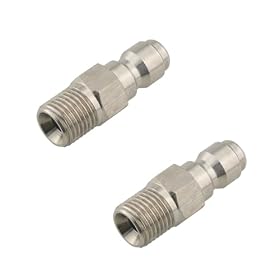
1/4-inch quick-connect socket: The gun accepts a small quick-connect plug, commonly used for spray tips, short wands, and some hose or gun connections.
1/4-inch quick-connect plug: The gun has a protruding plug and needs a matching socket.
M22 threaded connection: The gun uses a larger threaded fitting rather than a push-in quick-connect. M22-14 and M22-15 references describe different internal dimensions, so the thread label alone may not be enough.
Proprietary or molded connection: Some consumer pressure washer guns use a brand-specific hose or wand connector. A standard 1/4-inch fitting may not fit safely.
Do not rely on a listing photo alone. Measure the existing fitting only as a preliminary check, then compare its shape and connection details with the manufacturer’s parts information. A fitting that appears close can still leak, fail to lock, or restrict flow.
Know which side of the quick-connect you need
Quick-connect fittings are sold as plugs, sockets, adapters, and couplers. Match the gender and function of the part, not just its nominal size.
A male plug slides into a female quick-connect socket.
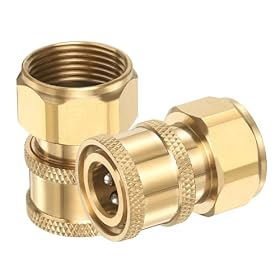
A female socket or coupler accepts a male plug.
A bulkhead, swivel, or threaded adapter may connect a quick-connect end to an M22, NPT, or other threaded connection.
For example, if your gun has a female 1/4-inch quick-connect socket and you want to attach a hose with a male plug, the hose needs the correct male plug. Buying another socket will not solve the mismatch.
Many listings describe a fitting as “1/4-inch quick connect” without clearly stating whether it is a plug or socket. Check the product diagram, connection-end photos, and included-part list before ordering.
Product prices and availability are accurate as of the date/time indicated and are subject to change. Any price and availability information displayed on Amazon.com at the time of purchase will apply to the purchase of this product.
1/4-inch quick-connect is not the same as M22
This is one of the most common sources of incorrect purchases. A 1/4-inch quick-connect uses a plug-and-socket mechanism. An M22 connection uses threads and a sealing interface. Neither one directly replaces the other.
You may need an adapter when:
The gun has an M22 threaded inlet but the hose has a quick-connect plug.
The hose has an M22 end but the gun or accessory uses a 1/4-inch quick-connect.
A spray gun uses a brand-specific connector and you want to use a standard hose or nozzle.
An adapter adds another sealing point and another possible restriction. Use one only when its thread type, seal, pressure rating, and connection profile are confirmed. Do not force a quick-connect plug into a threaded port or cross-thread an M22 fitting.
Product prices and availability are accurate as of the date/time indicated and are subject to change. Any price and availability information displayed on Amazon.com at the time of purchase will apply to the purchase of this product.
Check the fitting profile, not just the diameter
Quick-connects with the same nominal size may still use different profiles. The plug must have the correct shoulder, groove, ball position, and insertion length for the socket. Some fittings may connect physically but not lock securely or seal correctly.
Before buying, compare:
The plug or socket profile shown by the seller.
The outside shape and insertion depth of the existing fitting.
The locking sleeve or collar style.
Whether the fitting is intended for pressure washers rather than low-pressure air, irrigation, or general hydraulic use.
The connection material and seal type.
If the replacement is for a branded gun, search using the exact gun or hose part description from the owner’s manual. A generic fitting is appropriate only when the original connection is a standard, clearly identified profile.
Product prices and availability are accurate as of the date/time indicated and are subject to change. Any price and availability information displayed on Amazon.com at the time of purchase will apply to the purchase of this product.
Confirm pressure, temperature, and flow requirements
A fitting should be rated for at least the pressure and water temperature specified for your pressure washer. The rating needs to cover the complete assembly, including the hose, gun, adapter, and coupler—not just one isolated part.
Also consider flow. A small or restrictive adapter can reduce water delivery, increase pressure loss, or interfere with accessories such as a surface cleaner. This matters especially when converting between larger hose connections and smaller quick-connect fittings.
Look for product information that clearly states:
Maximum working pressure
Maximum water temperature
Connection size and profile
Compatible hose or gun connection
Material and seal information
Whether the fitting is intended for pressure washer use
Never exceed the lowest-rated component in the system. Follow the pressure washer and fitting manufacturer’s instructions, and replace a fitting that is cracked, badly corroded, distorted, or unable to lock securely.
Product prices and availability are accurate as of the date/time indicated and are subject to change. Any price and availability information displayed on Amazon.com at the time of purchase will apply to the purchase of this product.
Inspect the seal before assuming the fitting is wrong
A leak does not always mean the quick-connect size is incorrect. Check the seal and mating surfaces first:
Turn off the pressure washer and release pressure before disconnecting anything.
Inspect the O-ring for cuts, flattening, swelling, or missing sections.
Check the plug for burrs, dents, corrosion, or damage around the sealing surface.
Clean grit from the socket and plug with water and a soft cloth.
Make sure the plug is fully inserted and the locking collar returns to its locked position.
Replace a damaged O-ring with the correct size and material rather than stacking extra washers inside the fitting.
Do not try to stop a high-pressure leak by holding the fitting in place or wrapping exposed quick-connect sealing areas with thread tape. Thread tape belongs only on compatible tapered threaded connections, and the manufacturer’s instructions take priority.
Match the hose end and gun end as a complete system
A pressure washer hose may have different connectors at its two ends. One end might attach to the pump, while the other attaches to the spray gun. Before ordering a replacement fitting, identify both ends and determine whether the fitting is intended to be permanently installed or used as a removable coupler.
A useful compatibility checklist is:
Gun connection: quick-connect, M22 thread, or proprietary connector
Fitting gender: plug or socket
Profile: exact quick-connect style, not just nominal diameter
Thread standard: if an adapter is involved
Pressure and temperature rating: suitable for the machine
Seal: O-ring, gasket, or threaded seal designed for that connection
Flow path: large enough for the hose and accessory
Installation method: hand-tightened, wrench-tightened, or manufacturer-specific
If any one of these details is unknown, identify the original fitting or consult the pressure washer manufacturer before purchasing.
When an adapter is the right choice
An adapter makes sense when the gun and hose are both in good condition but use different, well-identified connection systems. For example, an adapter can convert a confirmed threaded connection to a confirmed quick-connect connection.
Choose a direct replacement instead when:
The original fitting is a proprietary part.
The gun body or hose end is damaged.
The fitting leaks after cleaning and seal replacement.
The adapter would require several stacked pieces.
The connection profile cannot be positively identified.
The fitting would reduce the rating below the pressure washer’s requirements.
Fewer connections generally mean fewer leak points. If the gun is inexpensive and the connector is molded into the body, replacing the gun may be more practical than attempting a repair.
A quick installation and leak check
After confirming compatibility, connect the fitting with the machine turned off. Make sure every quick-connect locks fully and every threaded connection is aligned before tightening according to the manufacturer’s instructions.
Start the water supply with the pressure washer off. Check for seepage at each connection. Then briefly run the machine while keeping the spray pointed in a safe direction and away from people, animals, electrical equipment, and fragile surfaces. Stop immediately if a fitting shifts, sprays from the side, or will not remain locked.
If the fitting repeatedly leaks despite a clean, undamaged seal and correct matching parts, stop using the assembly. The socket, plug, gun body, or hose end may be worn, and replacing the affected part is safer than forcing a tighter connection.
FAQ
Are all 1/4-inch pressure washer quick-connect fittings interchangeable?
No. They must also use the same plug or socket profile and be rated for the pressure and temperature of the washer. Nominal size alone does not guarantee compatibility.
Can I connect an M22 hose to a 1/4-inch quick-connect gun?
Not directly. You need a correctly matched adapter, and you must confirm the M22 variant, quick-connect profile, seal, pressure rating, and flow path before using it.
Why does my new quick-connect fitting leak?
Common causes include the wrong profile, a damaged or missing O-ring, dirt on the sealing surface, incomplete insertion, a damaged socket, or an incorrectly matched threaded adapter.
Should I use thread tape on a pressure washer quick-connect?
No. Quick-connects seal at their plug, socket, and O-ring surfaces. Thread tape is for compatible threaded connections only and should be used according to the fitting manufacturer’s instructions.