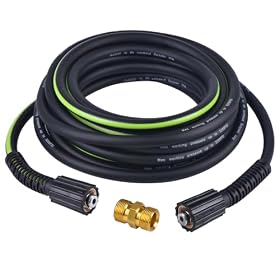
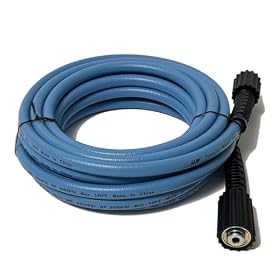
A replacement pressure washer hose must match your machine’s fittings, pressure rating, temperature rating, and connection style. Here’s how to choose one without risking leaks, poor performance, or equipment damage.
A replacement hose for a pressure washer needs to match more than the machine’s brand. Before buying, check the hose connections, maximum pressure, temperature rating, length, and inner diameter. A hose that fits loosely, cannot handle the washer’s output, or is intended for cold water only can leak, restrict performance, or fail under pressure.
Check compatibility first
Identify the connection type
Look at both ends of the original hose and the pressure washer outlet and spray-gun inlet. Common connection styles include quick-connect fittings and threaded fittings, but similar-looking threaded connections may not be interchangeable.
Check:
Whether each end is threaded or quick-connect
The fitting size and gender on each end
Whether the hose connects to the machine and gun directly or uses an adapter
Whether the original connection is metric, proprietary, or a common pressure-washer fitting
Do not rely only on a product listing that says a hose is “universal.” Compare the replacement hose’s fitting details with the pressure washer manual or the original hose. An adapter may solve a connection mismatch, but it can add bulk, leak points, or clearance problems.
Match the pressure rating
The hose’s maximum working pressure should meet or exceed the pressure washer’s rated operating pressure. Do not select a hose based only on the machine’s advertised peak or maximum pressure; use the operating specification in the manual when available.
A hose rated below the washer’s output is not a safe substitute. Leave a reasonable margin rather than choosing a hose whose rating barely matches the machine. Follow the hose manufacturer’s pressure and temperature limits as well as the pressure washer manufacturer’s instructions.
Check the temperature rating
For a cold-water pressure washer, a standard cold-water hose may be suitable if its other specifications match. Hot-water pressure washers require a hose specifically rated for hot water at the intended temperature.
Never assume that a hose designed for cold water can handle heated water. The wrong hose may soften, deteriorate, or fail.
Choose a useful hose length
A longer hose gives you more working range without moving the pressure washer, but it is heavier, takes more storage space, and may be harder to coil. A shorter hose is easier to handle but may require frequent repositioning of the machine.
Consider the job:
Vehicle washing: A moderate-length hose can make it easier to walk around the vehicle without dragging the machine.
House siding or patios: More length may reduce repositioning, especially when the washer stays near a water source.
Small cleaning jobs: A shorter hose may be simpler to store and handle.
Large properties: Prioritize a hose length that reaches the work area while keeping the machine on a stable, ventilated surface.
Do not connect multiple high-pressure hoses unless the manufacturers permit it and the combined setup has compatible fittings and ratings. Each additional connection can create another leak point.
Product prices and availability are accurate as of the date/time indicated and are subject to change. Any price and availability information displayed on Amazon.com at the time of purchase will apply to the purchase of this product.
Understand hose diameter and construction
The inner diameter affects water flow and pressure loss. A hose with a smaller internal passage may restrict flow, particularly on a higher-flow pressure washer or with a longer hose. A larger hose may carry water more easily but can be heavier and may not fit the original connections.
The outer construction also affects handling and durability. Look for a hose designed for high-pressure washer use rather than a general-purpose garden hose. Materials and construction vary, but useful features may include:
Flexible construction that resists kinking
Abrasion-resistant outer covering
Bend protection near the fittings
Fittings made from corrosion-resistant material
A smooth surface that is easier to drag and coil
A hose that repeatedly kinks can restrict flow and develop weak spots. Avoid sharp bends, crushing the hose under vehicle tires, and pulling the machine by the hose.
Product prices and availability are accurate as of the date/time indicated and are subject to change. Any price and availability information displayed on Amazon.com at the time of purchase will apply to the purchase of this product.
Inspect the old hose before replacing it
If the pressure washer is leaking or losing pressure, the hose may not be the only cause. Unplug the machine or shut off the engine, turn off the water supply, and squeeze the trigger to release trapped pressure before inspecting connections.
Check for:
Cuts, bubbles, bulges, exposed reinforcement, or flattened sections
Water leaking from the hose body
Damaged O-rings or seals at the fittings
Cross-threaded, cracked, or loose connectors
Debris blocking a quick-connect fitting
A hose that is kinked or tightly coiled during operation
If the hose body is damaged, do not patch it with tape or continue using it at high pressure. Replace it with a correctly rated hose. A damaged high-pressure hose can fail suddenly and create an injection or impact hazard.
Product prices and availability are accurate as of the date/time indicated and are subject to change. Any price and availability information displayed on Amazon.com at the time of purchase will apply to the purchase of this product.
Installation and safe use
Before installing the replacement, turn off the pressure washer and water supply. Inspect the mating fittings, install only the seals specified by the manufacturer, and hand-start threaded connections to avoid cross-threading. Do not force a fitting that does not align.
After connecting the hose:
Turn on the water supply with the machine off.
Check every connection for leaks.
Squeeze the spray-gun trigger to purge air.
Start the pressure washer according to the manual.
Recheck the connections at low load before beginning work.
Never point a pressure washer hose or spray gun at people, animals, electrical equipment, or yourself. Keep hands away from a suspected pinhole leak; high-pressure water can penetrate skin even when the damage appears small. Seek immediate medical attention for a suspected injection injury.
Product prices and availability are accurate as of the date/time indicated and are subject to change. Any price and availability information displayed on Amazon.com at the time of purchase will apply to the purchase of this product.
When an adapter is appropriate
An adapter can be useful when a replacement hose has a different connection style from the pressure washer or spray gun. However, confirm that the adapter is rated for the machine’s pressure and temperature. It should not reduce the connection to a weaker or incompatible fitting.
If you need several adapters to make a hose fit, the hose may not be the right choice. A direct-fit replacement usually reduces leak points and makes setup easier.
When to replace the hose, pump, or pressure washer
Replace the hose when it has visible damage, leaks from the body, has damaged fittings, or cannot meet the pressure and temperature requirements of the machine.
A hose replacement is less likely to solve the problem when:
Water leaks from the pump housing or unloader area
The spray gun leaks internally
The machine has adequate water flow but still has low pressure with a known-good hose and clean nozzle
The motor or engine will not start
The pump makes unusual noises or repeatedly loses prime
For pump, motor, electrical, or fuel-system faults, follow the manufacturer’s service instructions. Disconnect electrical equipment before inspection, and have a qualified professional handle repairs when the cause is uncertain or the unit requires internal electrical or pump work.
Quick buying checklist
Before ordering a replacement pressure washer hose, confirm:
The machine’s operating pressure
The hose’s maximum working pressure
Cold-water or hot-water compatibility
The connection type and size at both ends
The desired length
The hose’s inner diameter or flow compatibility
Whether included O-rings, adapters, or fittings are actually compatible
The return policy in case the connection does not match
The safest choice is a hose specified for your pressure washer or one whose fitting, pressure, temperature, and flow requirements clearly match the machine manual.
FAQ
Can I use any garden hose as a pressure washer hose?
No. The hose from the water spigot to the pressure washer is a low-pressure garden hose, but the hose from the pump to the spray gun must be designed for high-pressure use and rated for the machine’s pressure and temperature.
How do I know what size pressure washer hose I need?
Match the connection style and size at both ends, then check the hose’s pressure, temperature, and flow specifications against the pressure washer manual. Do not choose by outside diameter alone.
Is a longer pressure washer hose better?
A longer hose can reduce the need to move the machine, but it adds weight and storage bulk. Choose enough length to reach the work area without excessive slack, tight bends, or multiple unsupported connections.
Can I repair a damaged pressure washer hose?
Do not tape, clamp, or splice a high-pressure hose as a permanent repair. Replace a hose with cuts, bulges, exposed reinforcement, or leaks from the hose body with a correctly rated replacement.